Supplement Efficacy 2025: Data-Backed Performance Enhancer Comparison
Understanding the true impact of performance enhancers requires a critical look at scientific evidence, as the market for sports supplements continues to evolve with new data influencing choices for 2025.
As we navigate the ever-evolving landscape of fitness and nutrition, the question of supplement efficacy 2025 becomes increasingly vital for athletes and health enthusiasts alike. With countless products flooding the market, discerning which performance enhancers truly deliver on their promises, backed by solid scientific data, can be a complex task.
Understanding the Science Behind Performance Enhancers
The world of performance enhancers is often shrouded in marketing hype, making it challenging to separate fact from fiction. For 2025, a deeper dive into the scientific literature is more important than ever to understand how these supplements truly impact the body and athletic performance. This involves examining their mechanisms of action, dosage recommendations, and potential side effects.
Many supplements aim to improve performance by targeting specific physiological pathways. For instance, some may enhance energy production, while others focus on muscle recovery or reducing fatigue. The key is to look for supplements that have undergone rigorous, peer-reviewed studies, ideally with human subjects, to validate their claims.
The Role of Evidence-Based Research
Evidence-based research forms the bedrock of understanding supplement efficacy. Without it, claims are merely anecdotal. Researchers meticulously design studies to control variables, ensuring that any observed effects can be directly attributed to the supplement in question. This approach helps to build a reliable body of knowledge.
- Randomized Controlled Trials (RCTs): Considered the gold standard, RCTs minimize bias by randomly assigning participants to treatment or placebo groups.
- Meta-Analyses: These studies combine results from multiple independent studies to provide a more robust and comprehensive understanding of a supplement’s effects.
- Dosage and Timing: Research also helps determine the optimal dosage and timing for supplement intake to maximize benefits and minimize risks.
Ultimately, a critical review of scientific data allows consumers to make informed decisions, ensuring they invest in supplements that are not only effective but also safe. This scientific scrutiny is crucial for navigating the complex market of performance enhancers in 2025.
Creatine Monohydrate: The Gold Standard for Strength
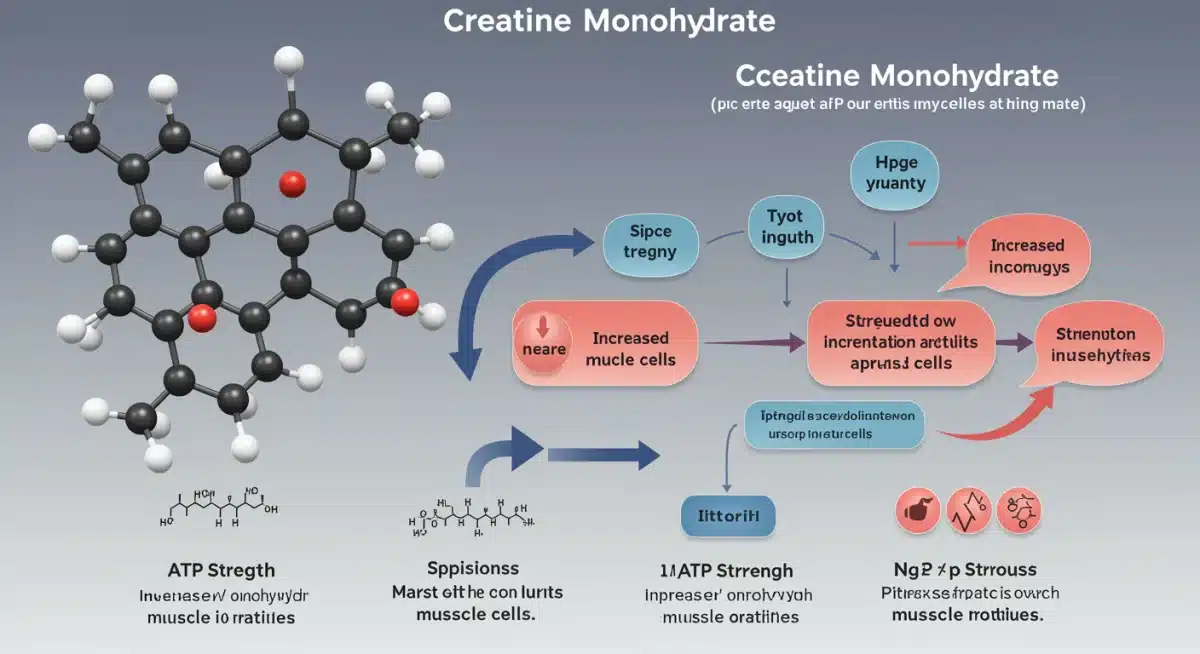
Creatine monohydrate remains one of the most extensively researched and effective performance enhancers available, a status it continues to hold firmly into 2025. Its mechanism of action is well-understood: creatine helps regenerate adenosine triphosphate (ATP), the primary energy currency of the cell, particularly during short bursts of high-intensity exercise. This leads to improvements in strength, power, and muscle mass.
Numerous studies have consistently shown creatine’s benefits across diverse populations, from elite athletes to recreational gym-goers. It’s not just about lifting heavier weights; creatine can also enhance exercise capacity and reduce fatigue, making it a cornerstone for anyone serious about strength training.
How Creatine Works in the Body
When you consume creatine, it is stored in your muscles as phosphocreatine. During high-intensity activities like weightlifting or sprinting, phosphocreatine rapidly donates a phosphate group to ADP (adenosine diphosphate) to reform ATP. This quick replenishment of ATP allows muscles to sustain high-power output for longer periods. This process is crucial for anaerobic activities.
- Increased ATP Production: Directly supports energy demands during intense exercise.
- Enhanced Muscle Growth: Creatine can draw water into muscle cells, leading to cell volumization, which may signal muscle growth.
- Improved Recovery: Some research suggests creatine can help reduce muscle cell damage and inflammation post-exercise.
The data unequivocally supports creatine monohydrate as a highly effective and safe supplement for enhancing athletic performance, particularly in strength and power sports. Its continued prominence in 2025 is a testament to its proven benefits and robust scientific backing.
Whey Protein: Essential for Muscle Repair and Growth
Whey protein continues to be a fundamental supplement for those focused on muscle repair, growth, and overall athletic recovery, maintaining its critical role in 2025. Derived from milk during the cheese-making process, whey is a complete protein, meaning it contains all nine essential amino acids necessary for muscle protein synthesis. Its rapid digestion and absorption rate make it an ideal choice for post-workout nutrition.
The efficacy of whey protein is well-documented, with extensive research highlighting its ability to stimulate muscle protein synthesis, aid in muscle recovery, and support lean muscle mass development. For individuals engaging in regular physical activity, especially resistance training, adequate protein intake is paramount, and whey protein offers a convenient and effective way to meet these needs.
Optimizing Protein Intake with Whey
While whole food sources of protein are always encouraged, whey protein supplements provide a practical solution for quickly delivering high-quality protein to muscles when it’s most needed. The timing of protein intake, particularly around workouts, can significantly influence its effectiveness in promoting recovery and adaptation.
- Post-Workout Recovery: Consuming whey protein immediately after exercise helps kickstart muscle repair processes.
- Muscle Mass Maintenance: Regular intake contributes to preserving and building lean muscle mass, crucial for metabolic health.
- Satiety and Weight Management: Protein is known to increase satiety, which can be beneficial for managing appetite and weight.
In conclusion, whey protein’s scientific backing for muscle repair and growth remains strong, solidifying its position as an indispensable performance enhancer for athletes and active individuals aiming for optimal physical development and recovery in 2025.
Caffeine: The Universal Performance Booster
Caffeine, widely consumed globally, stands out as a highly effective and readily available performance enhancer, a fact that remains consistent for 2025. Its primary mechanism of action involves blocking adenosine receptors in the brain, which reduces the perception of fatigue and pain, while also increasing alertness and focus. This makes caffeine beneficial for a wide range of athletic activities, from endurance sports to strength training.
The scientific literature on caffeine’s ergogenic effects is vast and overwhelmingly positive. Studies consistently show improvements in endurance performance, power output, reaction time, and even cognitive function during exercise. The versatility of caffeine makes it a popular choice for athletes seeking a competitive edge, provided it’s consumed responsibly.
Strategic Caffeine Consumption for Performance
While the benefits of caffeine are clear, optimal consumption requires careful consideration of dosage and timing to maximize performance enhancement and minimize potential side effects. Individual responses to caffeine can vary significantly, influenced by genetics and habitual intake.
- Dosage Recommendations: Typically, 3-6 mg of caffeine per kilogram of body weight is recommended for performance benefits, approximately 30-60 minutes before exercise.
- Reduced Fatigue: Caffeine’s ability to lower the perception of effort allows athletes to train harder and longer.
- Enhanced Focus: Improved concentration and alertness can lead to better execution of skills and strategies during competition.
The data confirms caffeine’s status as a powerful ergogenic aid, offering significant performance benefits across various disciplines. Its continued relevance in 2025 highlights its effectiveness when used strategically and in appropriate doses.
Beta-Alanine: Buffering Muscle Fatigue
Beta-alanine is a non-essential amino acid that has gained considerable attention for its role in enhancing high-intensity exercise performance, a trend expected to continue into 2025. Its primary function is to increase intramuscular carnosine levels, which act as a buffer against the accumulation of hydrogen ions during intense exercise. This buffering capacity helps to delay the onset of muscle fatigue, allowing for an extended period of high-intensity effort.
Research indicates that beta-alanine supplementation can significantly improve performance in activities lasting between 60 seconds and 240 seconds, such as repeated sprints, high-intensity interval training (HIIT), and specific sports like rowing or wrestling. While not as universally applicable as creatine, its benefits for specific types of exercise are well-supported by scientific evidence.
Maximizing Beta-Alanine’s Impact
To achieve optimal carnosine saturation in muscles, beta-alanine typically requires a loading phase, with consistent daily intake over several weeks. The most common side effect, a tingling sensation known as paresthesia, is harmless and can often be mitigated by dividing doses throughout the day or using sustained-release formulations.
- Increased Carnosine Levels: Directly leads to improved buffering capacity in muscles.
- Delayed Muscle Fatigue: Allows for more repetitions or sustained high-intensity effort.
- Synergistic Effects: Can be effectively combined with other supplements like creatine for enhanced overall performance.
In summary, beta-alanine is a valuable performance enhancer for individuals engaged in high-intensity, short-to-medium duration exercise. Its proven ability to buffer muscle fatigue makes it a relevant and effective choice for athletes looking to push their limits in 2025.
Branched-Chain Amino Acids (BCAAs): Recovery and Muscle Preservation
Branched-Chain Amino Acids (BCAAs), comprising leucine, isoleucine, and valine, are essential amino acids particularly valued for their roles in muscle protein synthesis, recovery, and reducing exercise-induced muscle damage. For 2025, their continued relevance lies in their direct impact on muscle metabolism, especially for those in caloric deficits or undergoing intense training regimens.
While a complete protein source like whey provides a full spectrum of amino acids, BCAAs are often highlighted for their specific benefits. Leucine, in particular, is recognized as a key activator of the mTOR pathway, which is crucial for initiating muscle protein synthesis. This makes BCAAs a popular choice for supporting muscle preservation during periods of fasting or intense training where muscle breakdown might be elevated.
Strategic Use of BCAAs
The efficacy of BCAA supplementation is most pronounced in specific scenarios, such as when overall dietary protein intake might be insufficient, or during prolonged endurance exercise to prevent muscle catabolism. For individuals consuming adequate protein from whole foods, the additional benefit of BCAA supplementation may be less significant, yet still present for targeted recovery.
- Muscle Protein Synthesis: Leucine’s role in stimulating the mTOR pathway is fundamental for muscle growth signals.
- Reduced Muscle Soreness: Some studies suggest BCAAs can decrease delayed onset muscle soreness (DOMS) post-exercise.
- Preventing Catabolism: During intense or fasted training, BCAAs can help reduce muscle breakdown.
Ultimately, BCAAs serve as a beneficial supplement for supporting muscle recovery and preservation, especially in contexts where muscle breakdown is a concern. Their role in a well-rounded nutritional strategy for 2025 is clear, particularly for athletes focusing on lean mass and recovery.
Navigating the Supplement Landscape: Key Considerations for 2025
With an abundance of options, successfully navigating the supplement landscape in 2025 requires more than just knowing what’s popular; it demands a critical understanding of individual needs, scientific evidence, and potential risks. The five performance enhancers discussed—creatine, whey protein, caffeine, beta-alanine, and BCAAs—represent some of the most well-researched and effective options available. However, their optimal application depends heavily on personal goals, dietary habits, and overall training regimen.
Before incorporating any new supplement into your routine, it’s crucial to assess whether your basic nutritional needs are being met through diet. Supplements are intended to complement, not replace, a balanced and nutrient-rich eating plan. A holistic approach that prioritizes whole foods, adequate hydration, and sufficient rest will always form the foundation of any successful fitness journey.
Personalized Supplementation Strategies
No single supplement regimen fits everyone. What works wonders for one athlete might have minimal impact on another, due to differences in genetics, training intensity, and body composition. Consulting with a qualified nutritionist or sports dietitian can provide invaluable guidance, helping to tailor a supplementation strategy that aligns with your specific objectives and health status.
- Goal Alignment: Choose supplements that directly support your primary fitness goals, whether it’s strength, endurance, or recovery.
- Quality and Purity: Opt for reputable brands that provide third-party testing to ensure product purity and absence of banned substances.
- Monitoring and Adjustment: Continuously monitor your body’s response to supplements and be prepared to adjust your intake based on results and any adverse effects.
In conclusion, the effective use of performance enhancers in 2025 hinges on a data-backed approach combined with personalized considerations. By prioritizing well-researched supplements and integrating them thoughtfully into a comprehensive health and fitness plan, individuals can maximize their potential and achieve their desired performance outcomes.
| Supplement | Primary Benefit |
|---|---|
| Creatine Monohydrate | Increases strength, power, and lean muscle mass. |
| Whey Protein | Aids muscle repair, growth, and overall recovery. |
| Caffeine | Boosts alertness, reduces fatigue, enhances endurance and power. |
| Beta-Alanine | Buffers muscle fatigue, improves high-intensity exercise performance. |
Frequently asked questions about performance enhancers
Creatine monohydrate is widely considered the most scientifically supported performance enhancer for increasing strength and power. Extensive research consistently demonstrates its effectiveness in improving ATP regeneration during high-intensity exercise, leading to enhanced muscle performance and growth.
No, whey protein is not exclusively for bodybuilders. While popular among them, it’s beneficial for anyone looking to support muscle repair, growth, and overall protein intake, including athletes, active individuals, and those aiming for general health and wellness. It aids in recovery and satiety.
Beta-alanine typically requires a loading phase of 2-4 weeks to significantly increase muscle carnosine levels, which are responsible for its performance-enhancing effects. Consistent daily intake during this period is crucial to achieve optimal benefits in buffering muscle fatigue during high-intensity exercise.
Yes, caffeine is well-known for its ability to improve endurance performance. It works by reducing the perception of effort and fatigue, allowing athletes to sustain activity for longer durations. Optimal dosages and timing are important for maximizing these benefits while minimizing potential side effects.
If you consume adequate protein from whole food sources, the additional benefits of BCAA supplementation might be less pronounced. However, BCAAs can still be useful for targeted muscle preservation during caloric deficits, intense training, or prolonged endurance exercise to help prevent muscle breakdown.
Conclusion
The landscape of performance enhancers for 2025 is rich with options, but true efficacy lies in understanding the science. Supplements like creatine, whey protein, caffeine, beta-alanine, and BCAAs have demonstrated significant benefits backed by extensive research. Making informed choices, aligned with individual goals and supported by a balanced diet and professional advice, remains paramount for optimizing athletic performance and overall well-being.